Showing posts with label SCOTUS. Show all posts

Thursday, March 17, 2016

Political Advice from the Past

I'm at a rare books library this week, with politics happily tuned down to a lower volume. That's true even though the library is around the corner from the Capitol Building, and almost across the street from the Supreme Court. So I was in town for Mitch McConnell's continued resistance to the eminent Merrick Garland, but I am busy doing other things.]
What do I have to say about Obama's strategy, and the Republicans' obstruction? Not much today; maybe next week. But I did get a piece of odd political advice in one of the 17th-century books I was reading yesterday. The book wasn't as useful as I had hoped it would be, and would be even less entertaining to you, but at one point the author (Thomas Scot, about whom you heard so much in grade school), throws out two couplets about the importance of guile and strategy in high office. First, he writes:

Not simple truth alone can make us fit
To beare great place in State, without great wit.

Honesty is not enough for high office; maybe necessary but not sufficient. Good-hearted simplicity is not a qualification. How that might apply to Obama and his antagonists, I leave for you to think through on your own. But Scot finishes his little epigram with these lines:

For when the Serpent comes to circumvent us,
We must be Serpents too, or else repent us.

And there, in honor of St. Patrick the expeller of serpents, is where I will leave it for today.

cross-posted from, and all comments welcome at, Dagblog

Monday, June 30, 2014

Religious Liberty vs. Hobby Lobby

Let's start with one thing. It is not acceptable for my boss to make my religious decisions. It is not acceptable for your boss to make your religious decisions, or for somebody else's boss to make religious decisions for them. Your religious freedom is yours, alone. It does not belong to your employer, to your landlord, or to anybody else. The deepest stupidity of the inane Hobby Lobby decision is that it uses religious freedom to let your boss take away your religious freedom. That is not acceptable. And it is not sustainable. Five allegedly rational Supreme Court justices have just opened the door to vicious religious conflict. Because letting your boss make your religious decisions is not acceptable, and over the long run people will not accept it.

I will admit that the Supreme Court and I come at First Amendment questions from different directions (although with a shared commitment to the First Amendment's value). They look back at it from the present day, viewing the Constitution as a point of intellectual origin. They understand its context and immediate antecedents, but their historical narrative is about the creation of the Constitution and the past two centuries of its interpretation. My scholarly work forces me to look forward to the Constitution. The writers and books I study are from an earlier period, inhabiting a world in which the Constitution is not yet imaginable. So I have gradually come to see the Constitution in terms of what went before, to see it as a set of codified solutions to particularly ugly historical problems. I don't have to imagine where we would be without Constitution or the Bill of Rights, because I have all too clear a picture of what the world without them was like.

The 16th and 17th centuries were periods of ferocious religious warfare, complete with terrorism, persecution, assassination, torture, inquisitions, and massacres of civilians. I use none of those terms figuratively. Kings were stabbed to death by religious fanatics. Religious leaders were burned alive in the public square. Conspirators plotted to blow up government buildings, to overthrow regimes. Women and children were beaten to death by mobs of their own neighbors. All of this was done by Christians to other Christians, and no denomination's hands were clean. If you look back at this history hoping to find that your own church behaved like the good guys, you will be sorely disappointed. Every existing Christian group played both the villain and the victim, more than once.

The hundred years or so before the Constitutional Convention saw the European religious conflicts modulate somewhat, so that religion became one volatile and dangerous wild card in larger games of international conflict and domestic factionalism. But religious intolerance and aggression did not go away. The settlement of the Thirteen Colonies was partly driven by the need to escape various forms of sectarian prosecution. And while the wars of religion were no longer the main show, they were certainly not gone. The last armed revolt aimed at putting a Roman Catholic on the English throne was in 1745. Benjamin Franklin was 39 years old at the time.

When I hear 21st-century American Christians complain about being persecuted for their beliefs, I am caught between laughter and disgust. Those people have no idea what real persecution is. And the danger to Christians has never been the secular state. The greatest danger to Christians; religious freedom is always other Christians. Secular government was devised to protect Christians from one another, and it is the only thing that has been shown to work.

The First Amendment guarantees free exercise of religion, and prohibits the establishment of any favored religion. The current religious right loves one clause and hates the second. They want freedom of exercise. They hate that the Establishment clause enforces a level playing field, and prevents one religious group's exercise from infringing upon others. Enormous bitterness is directed toward Jefferson's phrase "separation of Church and State," with endless tedious reminders that Jefferson's phrase is not in the First Amendment per se (but only a clear record of, ahem, original intention). But the fact is, you can't have one without the other. Religious freedom is only possible if the officially-secular state enforces a neutral playing field.

If we allow various Christian groups (or hypothetically other groups, although only Christians have that kind of political muscle in the United States) to use political or economic power to push their version of Christianity on others, the live-and-let-live "free exercise" arrangement falls apart. And then push comes to shove.

If certain parties are allowed to exercise their religious rights so vigorously that other people aren't free to make their own religious decisions, then no one can afford religious tolerance anymore. If my neighbor is permitted to impose his religion on me, then my only recourse is to drive everyone whose religion I disagree with out of the neighborhood. If the principal of the public elementary school has religious freedom to proselytize my (hypothetical) children, then I need to discriminate against certain potential principals on religious grounds, eliminating people whose beliefs I don't share. If a Mormon governor is liable to ban coffee shops, then I can no longer vote for a Mormon candidate. If people are using business to push religion, I can no longer do business with people of incompatible religions. That's a very bad outcome, but it's also the inevitable outcome.

If the government does not act as a referee, religious toleration becomes impossible, unworkable. If individuals are allowed to use whatever leverage they happen to have to coerce their neighbors or employees or tenants into conforming with their own religious beliefs, what you create is a competition in which people are forced to keep amassing more and more coercive muscle. The only way to keep your neighbors from jamming their religion down your throat is to organize some coreligionists and jam your religion down the neighbors' throats. That turns into persecute or be persecuted: a swift, ugly, and distinctly ungodly cycle.

What five of the Supreme Court justices have decided in Hobby Lobby is that religious coercion by non-government agents is actually a guaranteed right, and that the government cannot step in to prevent it because that would limit the coercive party's right to free exercise. That is a mind-bogglingly stupid position. And it ultimately leads back to the bad old days of sectarian infighting, where the only way to protect your own religious liberty was to trample everybody else's. I don't want any part of a country like that. I been there before.

cross-posted from Dagblog


Wednesday, April 03, 2013

Justice Roberts's Gay Marriage (and Mine)

The Supreme Court spent Holy Week (or, as Jesus would call it, Passover) debating gay marriage, which Chief Justice John Roberts clearly opposes. Religious opponents of gay marriage like to argue that the purpose of marriage is to beget children, so that only heterosexual marriages are "real," because only biological fertility makes a marriage "real." By this standard John Roberts's own marriage is not real, and neither is mine. I do not believe that, and neither should he.

John Roberts did not marry until 41, to a woman his own age, and they adopted their children. Justice and Mrs. Roberts are, as that link suggests, believing Catholics. That their marriage did not result in biological children does not make them less Catholic or less married. Roberts married an intellectual and professional peer rather than, say, a twenty-five year old. If he had married a twentysomething admirer, that hypothetical marriage would likely have led to biological children. Would such a marriage, to less closely-matched spouse, have been more authentic? More sacred? I do not believe so. I do not think Justice Roberts believes so, either.

Like Roberts, I did not marry until my early forties: a year and a half ago last Monday. Like Roberts, I married a person who was my equal or better intellectually, professionally, and emotionally. For me as for Roberts, that meant someone relatively close to my own age. And, like Roberts and his wife, my spouse and I share a faith life that is part of our marriage; as it happens, we and they belong to the same church. External circumstances make beginning a family out of the question for the near future; it would be irresponsible of me to father a child when I spend most of every week hundreds of miles away (just the thought of my wife entering labor while I am that far away from her opens a swampy pit inside my stomach). I am not less married because we do not have children. And I would not be more married if I had chosen a spouse with whom I could wait ten years to begin a biological family because she was half my age: God forbid.

I could not be more married than I am. My relationship with my spouse has become a fundamental element of my identity, whether I wake up beside her or two state lines away. Marriage is not just dating with tax benefits; it has the potential to transform and reorient your life, to change the way you move through the world. My marriage is part of who I am. And my spouse, to borrow John Donne's words, is the compass "who makes my circle just, and makes me end where I begun." I believe and hope that Justice Roberts's marriage gives him the same sense of purpose and the same consolations.

I do not believe that marriage is a means to an end, or simply a prerequisite to something else. Nor do I think anyone truly married can believe that. The purpose of marriage is to be married: to enter a lifelong relationship with your spouse. It is, as John Milton argued long ago, a remedy for the loneliness of the human soul: "against all the sorrows and casualties of this life to have an intimate and speaking help, a ready and reviving associate in marriage." Sex can be arranged by other means; childbirth can be arranged by other means, but, as Milton says, only marriage can satisfy the soul's thirst to join "to itself in conjugal fellowship a fit conversing soul ... many waters cannot quench it, neither can the floods drown it." The intellectual and spiritual companionship of marriage, not the potential for begetting children, is essential and irreplaceable.

Justice Roberts' spiritual and emotional bond with his wife, the essence of his marriage, is exactly what he would deny his fellow citizens because they have taken another man for a husband or another woman for a wife. The commitment to intense lifelong partnership comes to those who will not or cannot have children of their own body. That is as true for gay husbands and gay wives as it is for straight husbands and straight wives, as true as it is for John Roberts and his wife, as true as it is for my spouse and for me. Except for the privilege society offers to one class of citizen instead of another, John Roberts' marriage is a gay marriage, a source of profound spiritual and emotional nourishment that transcends the biological. The comforts and fulfillment of Justice Roberts's marriage, which I hope continue for many more years, are no less valid because he and his wife have not conceived children. But neither are the consolations of his fellow citizens' marriages any less real or valid because they, like Roberts and his wife, may not physically procreate. If John Roberts believes, as I trust he does, that marriage is a genuinely spiritual institution, then he should respect and honor the emotional and spiritual bonds of marriage. If mere biology invalidates such a bond, then John Roberts can no more be married to his true partner than two men or two women can be. Their marriages are as real as his, or mine. And to dishonor the sacred reality of those marriages dishonors his own.

cross-posted from Dagblog

Sunday, May 16, 2010

The Kagan Dog Whistle Gets Louder

cross-posted at Dagblog

Today, Ann Gerhart at the Washington Post came right out and said it: Elena Kagan's nomination to the Supreme Court is suspect because she is not a mother. So that dog whistle I was complaining about? It's a steam whistle now, very audible and very shrill.

I'm not going to link to the Gerhart's post, because bad behavior should not be rewarded with traffic. If you want to find it on the WaPo opinions page, her title is "The Supreme Court Needs More Mothers." No, I am not making that up.

Here is Gerhart's ringing conclusion:

In saying he wants justices who have "heart" and "empathy," and who understand "how our laws affect the daily realities of people's lives," Obama has invited us to ask who has a life outside work and who doesn't. That's hard to determine in a confirmation process that will require Kagan, like Sotomayor before her, to crimp her personality and bite her tongue.

Motherhood offers a one-word verifier. It signals a woman with an intensity of life experiences, jammed with joys and fears, unpredictability and intimacy, all outside the workplace. Much of the time, it's the opposite of being strategic and assiduously prepared.

It's a story we understand without needing all the details.

Heavens no, who needs details when we have handy stereotypes? As far as Gerhart's concerned motherhood is sufficient evidence if your intense inner life and your capacities for "unpredictability and intimacy" (are we hiring a Supreme Court Justice or writing a personal ad?), even if the nominee doesn't happen to be unpredictable, joyful, spontaneous, or capable of intimacy. Yes, parenting, as Francis Bacon tells us, exercises and strengthens our compassion, but not every father or mother is compassionate. By Gerhart's standards, Margaret Thatcher should be considered compassionate, but Jane Addams not. If you find those examples cheap and easy, they are. It only took three seconds to come up with them. But Gerhart didn't think that long.

Part of what's frustrating is that Gerhart enumerates the obstacles that today's women face and then offers a solution that scapegoats women. It's really hard to juggle motherhood and career, Gerhart reasons, and so women who choose to make their career the priority should be punished by, what was it? Oh yes, blocking their careers. Can't see anything unfair or unreasonable about that.

I'll try to explain this again, in words that even a WaPo Op-ed writer can understand (although Ruth Marcus needs no help, and her piece on Kagan is a gem):

It is paradoxically easier for women in the path-breaking generation in any field to juggle motherhood and career. How could that be? Because that generation of women doesn't need to worry about being slow-tracked if they get pregnant. They've been slow-tracked anyway. This is why Justice O'Connor could be a mother and the first woman on the Supreme Court. First of all, O'Connor's career was initially held back to an artificially slow pace (during her prime child-bearing years), because women lawyers had few or no opportunities. (Again, she finished 3rd at Stanford Law, and that didn't get her a job. Her classmate William Rehnquist, 1st in the class, had plenty of offers.) O'Connor had to break her own trail, slowly, and taking time off to start a family had a relatively low cost. Today's most promising young lawyers have to choose: a baby now, or a Supreme Court clerkship this year? A baby now, or bill extra hours to make partner at White, Shoe & Clubb? A baby now, or a chance to serve in the new Administration? O'Connor didn't have those choices. Secondly, as slow as progress is for women in the ground-breaking generation, there are still no other women ahead of them. O'Connor could take her winding route to nomination, raise a family, and still be one of the most qualified female Republican lawyers in the United States when she was nominated. That is no longer true for women who made law review at top schools. They are no longer alone, but they also no longer have the field to themselves.

I've seen this first hand, watching my mother break into a field that had always belonged to men. I could watch, because my mother had me before she started that career, and even before she had gone to college. (The first time I ever entered a college classroom, it was because Mom's baby-sitting arrangements had fallen through.) But even with that late start, Mom was always unusually qualified for a woman police officer her age. It was unusual for her even to be a police officer. Everything she did and everywhere she went, she was going first. There were no female peers for her to be measured against. But the first woman to lead the NYPD or LAPD or the FBI won't be the only woman in the NYPD, LAPD or FBI; she'll be one women among many, and they'll all face hard choices about career and family.

What's repulsive about Gerhart's argument is that none of these standards are applied to male nominees. No one's asking if male nominees are dads, or how much attention they actually spare for my children, nor should we. I might be more sympathetic to the nominate-more-mommies argument if we demanded that people like Roberts and Alito coach spend a certain number of hours flying kites or coaching Little League, but not much more sympathetic, because applying a foolish standard universally doesn't make it less foolish. We demand intellectual achievement and legal heft from our nominees, and that's fine. It's just from the women that we demand intellectual achievement, legal heft, musical laughter, a devil-may-care smile, and experience catching fireflies in bottles on summer nights. A male justice has to be a judicial heavyweight. A female justice apparently has to be a judicial heavyweight and a character in a Bronte novel. (Although if she is openly emotional, or even just a Latina, her emotionalism is suspect.)

And what's truly repellent about Gerhart is her traffic in the ugly saw that childless women lack full emotional lives. Everybody knows, of course, that a woman who doesn't get married and have kids, and most especially a high-achieving woman who doesn't get married and have kids, is entirely out of touch with her inner life, deprived of her full capacities to imagine, intuit, hope, and feel.

You can ask the Bronte sisters about that last one, too.

Thursday, May 13, 2010

The Kagan Dog Whistle

cross-posted at Dagblog

Suddenly, with the Elena Kagan nomination, careerism is a terrible thing.

When John Roberts was the nominee, it was all about the splendid qualifications of his splendid career. Much the same when it was Samuel Alito. When Sonia Sotomayor was the nominee, it was all about whether or not her qualifications were actually qualifications, what with her being a Latina and all. (If you get a summa cum laude from Princeton but you're not white, how can Pat Buchanan be sure you can even read English?) But everyone agreed that the big questions were career and qualifications. Now that Kagan has been nominated, some people are complaining that to be this qualified, she must have spent her entire adult life pursuing those qualifications! My goodness! Anybody with such an impressive career must be a ... a ... a ... careerist!

Can you hear the dog whistle yet?

David Brooks is terribly, terribly worried that Kagan is a careerist "Organization Kid," who has repressed her true self to get ahead: "prudential rather than poetic," calculating rather than passionate. (Why any rational person would want a poetic judge rather than a prudential one is beyond me.) Andrew Sullivan is scared, too, because Kagan's "life, so far as one can tell, is her career" which has kept her from taking bold, passionate positions. What bold positions? Coming out as a lesbian, of course, which is Sullivan's chief demand, Kagan's actual desires, in every sense of that word, notwithstanding. According to Sullivan, Kagan's "entire life seems to have been a closet - in the pursuit of a career."

Can you hear it? It's pitched very, very high.

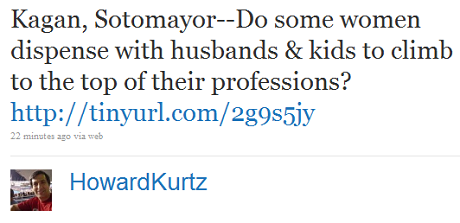
Oh, fine then. Here is twittering twit Howard Kurtz, answering the whistle and salivating:

Kagan, Sotomayor -- Do some women dispense with husbands and kids to climb to the top of their professions?
http://tinyurl.com/2g9s5jy
Howard Kurtz
(h/t John Cole, whose post on Kagan is superb)

Whoops. There it is. You see, Kagan has been so focused on her career that she's left no time for her personal growth. (Nudge, nudge.) She has turned her back on her own passions. (Wink) She needs to get off the career track for a little while and do things that wouldn't help her resume but which are, you know, personally fulfilling. (Nudge, wink, nudge, wink.) That would make her more emotionally well-rounded. Otherwise, of course, she must be passionless, emotionally stunted, and estranged from her real self. Probably a lesbian, too.

Only Kurtz is clumsy enough to say it aloud. That's why it's a dog whistle. But it's meant to summon up familiar anti-feminist stereotypes about career women, and about the horrors of sacrificing one's "natural" maternal destiny in order to pursue a professional career. The point of those stereotypes is not to deal with the genuine difficulties facing women who want both motherhood and careers, but to intensify those difficulties, and to make the option of forestalling or foregoing motherhood appear illegitimate. The argument is that women who aren't mothers, and most especially women who aren't mothers because they have been pursuing careers, aren't real women at all. And of course, since they're not real women, they don't know what they really want.

This is why one 50-year-old nominee was presented as brilliant, poised, and prudent while an essentially identical 50-year-old nominee is presented as a repressed, wonkish automaton. Elena Kagan isn't any more of a careerist or a nerd than John Roberts was. Who could be? And no one imagines Roberts as less authentic or less human, let alone less manly, because he delayed marriage until after he was forty. No one faults a man who postpones starting family life while building his career.

It's startling the extent to which the press coverage of Kagan has been dominated by her childlessness and her apparent partnerlessness. On one hand you have the must-be-gay storyline, with its breathtaking ignorance of the choices professional women in our society face. (I have no idea who Elena Kagan likes to sleep with, but I know that there are many, many successful women who have trouble finding appropriate and supportive partners. To treat the fact that Kagan is single as some inexplicable oddity, which must be hiding a deep personal secret, is to indulge in the luxury of not having to notice certain basic facts. ) On the other hand, you have the "careerist" meme, which is inseparable from the stereotypical ways in which career women are imagined in American society. Either way, it boils down to the same ugly idea: whenever a woman gets to the head of the class, her femininity is suspect. So she needs to prove that she's a real woman. Bullshit, I say. It stinks.

Let's face some hard facts about the Supreme Court nominating process these days. The two key demands are that the nominee must be indisputably, even overwhelmingly, qualified (because the opposition party will attack any weakness) and that the nominee be as young as possible, preferably 50 or so (so that the nominating party keeps the seat as long as it can). Those two requirements demand a candidate who's been on the fast track for his or her entire career. All of the hand-wringing about the way everyone on the court is from Harvard or Yale Law stems from this. The only way to become impeccably qualified for the Supreme Court by age 50 is to get a hot start and keep it in high gear for three solid decades: clerking at the Supreme Court, followed by a series of plum appointments in some mixture of high-powered firms, the federal judiciary, government service, and Top 5 law schools. Lawyers who begin without elite pedigrees and influential recommendations can build an equally powerful resume, and sometimes achieve more than their peers from Harvard, Yale and Chicago, but it will take them longer. When someone from a merely excellent law school is qualified for the Court, they will likely be 60 or 65, rather than 50. The nominees we're seeing are all, necessarily, careerists: there's no longer any time to relax if you're going to be ready for nomination before you're too old to nominate.

Keeping this blistering pace also doesn't allow much time for bearing children. It's possible for men to stay on the new future-nominee schedule and start a family, because they don't need to sacrifice their time or energy to pregnancy, and because it's easier for them to find partners who will take on more of the child care. That doesn't mean that professional women can't have children and be successful; it just means that it takes longer. Ruth Bader Ginsburg has children, but she was 60 when she was nominated, and that's still starting from both the Harvard and Columbia law reviews. Sandra Day O'Connor managed to have children and get to the Court by 51, and she'd taken a more interesting, less fast-track route to nomination, but that was because O'Connor wasn't originally allowed on the fast track; she graduated third in her class from Stanford Law and no one would hire her as a lawyer. Future women nominees with careers like O'Connor's won't seem "qualified," because talented female lawyers are recruited to the inside track now. A nominee like Joan Roberts might manage to have both career and children, but only if she doesn't get married until she's 41 and then adopts her children rather than bearing them. (Oh, I'm sorry. That was John Roberts. Forget I said anything.)

If all of this seems abstract or hypothetical, consider the case of Judge Diane Wood, who was on the short list for each of Obama's Supreme Court nominations so far. Wood is eminently qualified, has three children, and got her law degree from the University of Texas rather than Harvard or Yale. But Judge Wood is already 59, and will be 60 on the Fourth of July. As pundit after pundit has opined over the last month, that's now considered problematically old.

Might we eventually see female nominees to the Court who've managed to build up intimidating
qualifications by age 50 (or 52 or 48) and still had children? Of course. But it's a flat denial of reality to treat that profile as the rule and a profile like Sotomayor's or Kagan's as the exception. Kagan and Sotomayor are far more normal, and far more typical considering their professional circumstances. Elena Kagan became Dean of Harvard Law School when she was 43 years old. Apparently, some people (including a guy who became editor of The New Republic at 28) feel that this should be held against her. If she'd taken the time off (and I mean the minimum medical time) to start a family, she probably would not it have made it so far, so fast, and that would have been held against her, too. She has worked incredibly hard, drawing on formidable talents and resources, to make herself fit for national service, and faulting her for that is downright ungrateful.

Elena Kagan has no passions? Who are we kidding?