Wednesday, September 09, 2009

The Preston Brooks Award


Representative Joe Wilson, of South Carolina, called the President of the United a liar tonight, while the President was in the House Chamber addressing a joint session of Congress. This isn't news to any of you; it was quite startling.

Shocking as this was, this wasn't the worst breach of civility a Congressman from South Carolina has ever committed. That dubious honor goes to his predecessor Preston Brooks.
I hereby nominate Congressman Wilson for the Preston Brooks Award, an irregular honor to be given to Members of Congress whose incivility undermines our civil institutions and the integrity of our public debate. May Wilson hold the award unchallenged for many years to come.

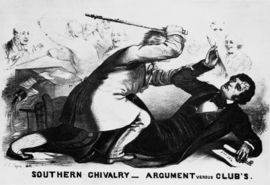
Preston Brooks, Congressman of South Carolina, walked into the Senate Chamber in 1856 and beat Senator Charles Sumner over the head with a cane. Sumner had to be carried from the chamber, unable to walk; he could not see because of the blood in his eyes; his desk was torn from its place on the floor when he took shelter under it. Brooks felt that Sumner had been discourteous in a floor speech, and beat Sumner because he felt the Senator had not been civil enough. Sumner was not well enough to resume his duties until 1859; the Massachusetts legislature actually returned Sumner to the Senate that time, because they felt that his empty chair in the Senate Chamber spoke more eloquently than any successor could do.

Brooks refused to apologize, survived an expulsion vote, resigned anyway (because he was affronted that anyone would impugn his character by voting for his expulsion) and was re-elected as a triumphant hero by his constituents. In the sectionalism leading up to the Civil War, Sumner was treated as a martyr in the north, and Brooks was lionized throughout the South. (There are towns named after him in Georgia and Florida.) And the Civil War came all the closer for it.

The beating was a sign of terrible sectarian division, and aggravated that division. But the partisan whooping and cheering that followed was a far worse sign, and in the long run even more corrosive. If the spirit of Preston Brooks moved another South Carolina Congressman tonight, in a small way, the question the rest of us have to ask is how we deal with it tomorrow. If all parties can agree that his behavior was out of place, then we're still having a healthy public debate. If, on the other hand, we see a backlash against criticism of Wilson, if the radio charlatans and cable shouting heads decide to defend him tomorrow, then it's a sign that out national discourse is fraying, and reasonable solutions are drifting further out of reach.

Charles Sumner's seat in the Senate Chamber stands empty again tonight. It is, of course, Senator Kennedy's seat. And tonight a sitting President ended his speech to both Houses and our nation by appealing to the eloquence of that empty chair, and of its sorely-missed occupant. There's poetry in that, but chance and history wrote the poem.

Tuesday, September 08, 2009

Firing Van Jones Is a Win ... For Liberals

As galling as it is to discover flaws in anyone Glenn Beck attacks, I'm not sorry that Van Jones resigned. Signing a petition that calls for "investigating" the truther conspiracy theories is actually a superb reason to not work in the White House. Van Jones shouldn't work in the White House. Neither should anyone who endorses the birther lunacy, even if it's just signing a petition they later deny believing in, should be allowed in any future Republican West Wing.

There's a feeling, I understand, that Glenn Beck shouldn't be allowed to "win." But what has Beck won? Advertising endorsements? No. Beck got someone who founded the group that's promoting his boycott. Maybe he feels some personal satisfaction. But the canning of Van Jones doesn't mean advertisers are signing back on to Beck's show. He's gotten some petty revenge. But he hasn't gained anything for himself.

Has the Jones resignation made Obama look bad, or weak? Only to people, whether on the left or right, who already thought Obama was bad and weak. Only the hardest-core political junkies noticed the Van Jones story at all, because the lunatic right stepped on the story. The opportunity to make Obama's White House looks like a truther loon sanctuary was cast aside in the giddy assault on Obama's dangerous socialist speech about studying hard.

Liberals are actually in luck. The lunatic right overlooked the first nugget of genuine leftist irrationalism they'd happened across for months and months, because they were so eager to run out and prove themselves irrational and irresponsible. I rejoice at their timing.

We have to meet the crazies with sanity, not with more crazy, and it's important not to confuse political passion with political credulity. Being willing to believe any crazy silly thing doesn't make you a more passionate or more committed leftist. It makes you an undisciplined and ineffective leftist. In the long run, and too often in the short run, it makes you a liability.

Being the mirror image of the Rump Republican Party is not a strategy for victory. There is no advantage in adopting the opposition's folly and weakness. "If the enemy," as a character in Shakespeare puts it, "is an ass, and a fool, and a prating coxcomb, is it meet, think you, that we should also ... be an ass and a fool and a prating coxcomb?" Being a truther is an attempt to match the right wing craziness with more craziness, like fighting kamikaze pilots by crashing your own plane.

Liberals and progressives need to defeat the crazy right on the ground of cold hard, sanity. Keeping around truthers and other conspriacy theorists only muddies that crucial division between the party that wants to move the country forward in real ways that help real people and the party that is mired in its own fetid paranoias. We need to represent the reality-based community, all day every day. That's the only way to win and the only way to deserve to win.

And the plain unpleasant fact is, the left has no route to victory except virtue. Playing down and dirty in the swamps of paranoia and conspiracy will always be a losing strategy for progressives. Conservative fantasies and fear-mongering will always have a wider and deeper pull in the public imagination than progressive fantasies will; the conservative fantasies are deeply familiar and grounded in long cultural traditions; they come easily. Being progressive is precisely about doing the good that we have to imagine into being, the things we have to work to imagine. Imagining a better world is hard work. It's always easier to fall back into old, comfortable fears. We will never win by talking about the monsters under the voters' beds; the right wing fringe midwived those monsters, long before we were born.

Friday, September 04, 2009

Beginning a List

I've heard so much about socialism these days, and the word clearly doesn't mean what I think it means, or really what any of the dictionaries say it means. So what is this socialism that people keep accusing Obama of? What do the people who call him "socialist" mean by that?

Formal theoretical definitions aren't so much the way to go. So I'm going to start a purely descriptive list, cataloging the Obama policies that are labeled "socialist."

Let's start with
Florida GOP chairman Jim Greer, who this week called President Obama’s planned speech to school children an attempt to “indoctrinate America’s children to his socialist agenda,”

OK, so:

1) Socialists tell children to work hard and stay in school.

Got it.

I think there are a lot of socialists around these days. George H. W. Bush, you Andover pinko, I'm looking at you.

(h/t http://www.dailykos.com/storyonly/2009/9/3/776437/-Late-afternoon-early-evening-open-thread)

Thursday, July 23, 2009

Police Discretion

There's already been a lot of virtual ink spilled about the Gates arrest, and now about the President calling the arrest stupid. Ta-Nehisi Coates has terrific posts, and terrific threads, about both, and I'm using my blog to put together some of the thoughts those threads brought up for me. As someone from a police family, I think that arrest was stupid. It was a glaring piece of bad judgment.

Even according to the arresting officer's report, this is very much a discretionary arrest. There are such things. If every law on the books was constantly enforced with arrest, we'd live in a bizarre and palpably unjust world. Every loiterer should not be fined. Everyone drunk in public should not spend a night in the drunk tank. Every piece of disorderly conduct should not lead to an arrest. Any time a police officer makes one of those arrests, he or she is using her discretion. It's a judgment call.

Should these laws be taken off the books? No. Do they give the police too much leeway? Not necessarily. Police need some tools to manage difficult situations in real time in the interest of public safety. The ability to arrest people, to remove certain parties from a situation that's looking volatile, is an absolutely necessary tool. If you've got some truculent drunks in a crowd after a sporting event, who are on the verge of starting a fight, public drunkenness is a great arrest to make. If you want to keep two large groups of teenagers from brawling, the no-loitering law is perfect. If someone is legitimately creating a public danger, disorderly conduct arrests can defuse the situation.

But here's the thing. Exactly because these arrests are discretionary, they put the burden on the police officer to use discretion and good judgment. These are laws that are basically designed not to be enforced most of the time. The point is that the officer is supposed to apply these laws judiciously, in the interest of public safety. A drunk twenty-something leaning on a designated driver's arm? Not an arrest. A drunk twenty-something screaming threats at a guy in a Yankees cap? Arrest-a-mundo.

Most of all, discretionary arrests should not be used by a police officer to vent spleen or avenge insults. They often are, but that is not policing. That is public bullying. Disorderly conduct should not be charged simply because someone displeased a police officer.

The arresting officer's report, which is by its nature a one-sided and adversarial document, can't really make the case that Gates had to be arrested. It only makes the case that Gates could be arrested. And for a disorderly conduct charge, that isn't enough. Any talk about how Gates comported himself is beside the point. Being a jackass, and we only have the arresting officer's word for that, is still not an arrestable offense. And as for the defense that Sgt. Crowley was "just doing his job," I would point out that his job is to use his discretion. He certainly wasn't protecting anyone when he arrested Gates. And he wasn't using his judgment. He was just being, to put it as charitably as possible, stupid.

I believe that Crowley knew from almost the beginning of the interview that Professor Gates was not a threat to him. The fact that Crowley entered Gates's home (as all parties agree) by himself and without backup, gives that away. If he went into that house without backup (especially when the initial report mentioned two suspects) before knowing that there was not a crime in progress, then he would be an enormous fool. That he walked into Gates's home alone suggests that he knew he was dealing with a safe situation.

After Gates had identified himself as the homeowner, and shown ID (which all parties agree, although they differ on details), and after, as Sgt. Crowley himself reports, Crowley believed that he was dealing with the legitimate resident, there was no further police work to do. (Certainly, he should not have continued to ask the resident questions after that. What reason could there be?) Crowley should have been on his way. Ideally, a few conciliatory words along the line of "Sorry to disturb, just doing our jobs," would have helped, but Crowley was also free to scowl and depart.

What happened next, with Gates being arrested and cuffed on his porch, has nothing to do with public safety. Even if Gates behaved every bit as badly as Crowley claims, Gates's vocal and arguably "disorderly" displeasure was not going to be a threat to anyone else's safety. There wasn't going to be any mayhem on Ware Street. I'm not entirely sure that the laws of physics permit mayhem on Ware Street in Cambridge. If Gates had genuinely lost his temper, then Crowley should have allowed him to sputter on his porch and embarrass himself. Instead Crowley reached for his cuffs and made everything into a bigger deal. Was that stupid? There's no way on Earth to call it smart.

Monday, July 06, 2009

Palin, Douthat, Class and Education

Ross Douthat has an equivocal defense of Sarah Palin, or rather a lyrical defense of the-Palin-that-might-have-been in Douthat's hopeful hypotheses, in the Times. He cops to the damage that Palin has done to herself and to her own political future, but also throws a lot of blame on the media for misrepresenting her. I disagree with Douthat broadly: I do not think that there is another Palin, or that she would have performed better in different circumstances. I think there's one Sarah Palin, here in the phenomenal world, and I think we're looking at her.

But I really want to take issue with a narrower point, about how Douthat frames Palin's agenda:

Palin’s popularity has as much to do with class as it does with ideology. In this sense, she really is the perfect foil for Barack Obama. Our president represents the meritocratic ideal — that anyone, from any background, can grow up to attend Columbia and Harvard Law School and become a great American success story. But Sarah Palin represents the democratic ideal — that anyone can grow up to be a great success story without graduating from Columbia and Harvard.


That is genuinely a nice distinction on Douthat's part and the tension between small-d democratic impulses and meritocratic impulses go all the way back through our history. (Part of my Independence Day reading has involved the election of 1800; 'nuff said.) But Douthat is collapsing another important distinction: that between hostility toward class and hostility toward education per se.

One can dislike Harvard and Columbia for class-based reasons, as bastions of elitism, and that's an eminently reasonable position, even for Harvard alumni with columns at the New York Times. But some dislike Harvard, Columbia, and the rest of the Ivies because they dislike education itself. There's an anti-elitist position and a know-nothing position. One has merit. One does not. Richard Nixon might legitimately scorn Harvard, where he could not afford to go although he earned admission. But Nixon never scorned learning itself. Lincoln, the greatest of our up-by-the-bootstraps politicians, valued education tremendously.

The question here is whether Palin is the class warrior Douthat imagines or a simpler, less laudable, know-nothing . Douthat feels that she's a failed or incompetent Andrew Jackson:

he’s botched an essential democratic role — the ordinary citizen who takes on the elites, the up-by-your-bootstraps role embodied by politicians from Andrew Jackson down to Harry Truman.


But perhaps she's "botched" this role because she's not trying to perform it. Perhaps she isn't fumbling Douthat's agenda, but has one of her own that Douthat himself could not embrace.

It's very clear from her public words and actions that Palin does not merely resent educational privilege, but education itself. She resents knowledge. She resents learning. She resents anyone who is smarter than herself, which is a very significant slice of humanity. Palin doesn't simply view Harvard and Columbia as elitist; she views state colleges as elitist. She's against knowing stuff.

How can we test this? We could look at her education policy. How does she support the University of Alaska system? Surely, the University of Alaska is not about eastern snobbery or old-money prestige. It's about students learning things.

And while we're at it, we should consider, as the best evidence of all, Palin's hostility to public libraries in her state. Public libraries are anti-elitist education at its purest and best. They give no degrees. They have no cachet. They have no lacrosse teams or school ties. They're just about information, about learning for everyone. They are the places where many of our greatest American autodidacts, and there's a glorious tradition, have begun to pull themselves up by the public bookplates.

Palin, naturally, hates them.