The Tamir Rice story, and the irresponsible decision not to prosecute his killers, is breaking my heart. And while the worst sufferers are Tamir's family, I have found myself thinking, ever since he died, about the poor soul who called 911. That person was just trying to do the right thing, but the positive, neighborly gesture led to disaster. Calling 911 brought the Cleveland Police, and because the police came a child died. Everything would have better if the police had not come.
I wonder about that 911 caller, who did the right thing and will have to wrestle with guilt because in Cleveland that became the wrong thing. The 911 call specifically said that the person in the park was probably a kid and the gun was probably a fake. Those caveats got stripped away, and the police rolled right up on the poor boy, got out of their patrol car car, and immediately shot him dead. Then they stood around let the child bleed to death.
Before we go through the apologists' spin doctoring, let's remember three things:
1. Tamir got shot within two seconds of the police's arrival. They did not give him time to comply with any order. I do not think they gave the boy time even to comprehend their orders.
2. The fake gun was still tucked in Tamir's belt when he was killed. The police never saw it in his hand.
3. Even Tamir had been a grown man with an actual pistol, THAT IS NOT AGAINST THE LAW in Ohio. Ohio, for better or worse, is an open-carry state, which means that people have the legal right to carry a gun openly in parks. The cops shot him dead although there was no crime being committed, and no appearance of a crime being committed.
That is to say, there was no crime being committed until the cops arrived. The police themselves became the menace, not for the first time in Cleveland, destroying the civil peace they were sworn to protect.
And that leads us back to the problem of the 911 caller. Because one of the practical lessons here is: do not call the police. They are too dangerous. What should be the safe and neighborly thing to do has the most gruesome unintended consequences, because the police turned a kid fooling around on a playground into violent death. I'm sure that caller won't be quick to call the cops back to the neighborhood. How could you be?
And this is just one particularly stark and ugly example of the ways that bad cops destroy good cops' ability to do their jobs. Police work depends on neighborhood cooperation. Always has, always will. It's impossible to solve most crimes without neighbors providing tips and serving as witnesses. (The prevalence of CSI-style procedurals on TV is partly about denying this fact. In the real world, solving a felony with DNA evidence alone is rare.) Keeping peace and preventing crime depends on neighbors being willing to call 911. When you teach a neighborhood not to call the cops and not to trust the cops, because the cops themselves have proved themselves untrustworthy, you are making real police work nearly impossible.
It's not justice or peace. The police are sworn to uphold both. By endangering the citizens they are sworn to protect, they not only pervert their sworn charge, but make it impossible for any peace officer to do the job correctly.
cross-posted from, and all comments welcome at, Dagblog
Tuesday, December 29, 2015


Thursday, December 24, 2015
The Christmas Star
It's Christmas, the second-most-important Christian holiday and the most important holiday for many Americans. Tonight is Christmas Eve. But for some families, every year, Christmas comes at a moment that seems dark and difficult. Many of my friends are in my thoughts tonight, and my own family is grieving.
This will be our last Christmas with Mom. My mother is in hospice. She spoke during the fall about wanting to make it to Christmas, and she has. I am immensely thankful. I am very sad. We have her; we will lose her. The two truths are not separate.
The winter holidays are about celebration and gratitude. Celebrating is easy. Gratitude is harder. In the good years, in our well-fed and endlessly-indulged country, being grateful for our easy bounty often poses an enormous challenge.We take so much for granted, and understand too little of it as a gift. But when Christmas comes to you in the bleak midwinter, gratitude is even more important. You must dig deeper to bring up your thanks. But this is the most important time to be thankful.
I am grateful, tonight, for all the years of my life that I have enjoyed my mother's love. I am grateful that this Christmas I will see her face and hear her voice. And I am grateful, more than I can ever say, to the family that has supported and surrounded her during her illness. Everything I want for Christmas I have; I have already been given it, year by year and day by day, all the days of my life.
There is a reason that this holiday comes at the dark ebb tide of winter. It is the holiday of consolation in the darkness. The Christian story tells of a miraculous birth in the dead of winter, far from any riches or comfort, in the most unlikely of places. And it offers, in the long night of the spirit, a promise of far-off hope.
That promise is not about tomorrow. There is a reason that Easter is the most important day of the Christian's year, and Christmas the second. Easter is the fulfillment of hope. Christmas is hope that has yet to be fulfilled. Santa aside, Christmas has never been about immediate gratification. The child is born, and nothing outward or immediate changes. He is a baby; his great deeds, his historic role, are decades away. Everything will change, but not yet.
Christmas is not about hope fulfilled, but about hope itself: the faith that the better day will come, no matter how long tonight may last. The promise is fulfilled by being renewed, and we are asked to wait again, to hold hope quietly in our hearts through the long, gray winters. It offers us only the reassurance of a distant star, just above the horizon, clear and steady but beyond our reach. All it promises is that the star is there. And that will be enough.
cross-posted from (and all comments welcome at) Dagblog
This will be our last Christmas with Mom. My mother is in hospice. She spoke during the fall about wanting to make it to Christmas, and she has. I am immensely thankful. I am very sad. We have her; we will lose her. The two truths are not separate.
The winter holidays are about celebration and gratitude. Celebrating is easy. Gratitude is harder. In the good years, in our well-fed and endlessly-indulged country, being grateful for our easy bounty often poses an enormous challenge.We take so much for granted, and understand too little of it as a gift. But when Christmas comes to you in the bleak midwinter, gratitude is even more important. You must dig deeper to bring up your thanks. But this is the most important time to be thankful.
I am grateful, tonight, for all the years of my life that I have enjoyed my mother's love. I am grateful that this Christmas I will see her face and hear her voice. And I am grateful, more than I can ever say, to the family that has supported and surrounded her during her illness. Everything I want for Christmas I have; I have already been given it, year by year and day by day, all the days of my life.
There is a reason that this holiday comes at the dark ebb tide of winter. It is the holiday of consolation in the darkness. The Christian story tells of a miraculous birth in the dead of winter, far from any riches or comfort, in the most unlikely of places. And it offers, in the long night of the spirit, a promise of far-off hope.
That promise is not about tomorrow. There is a reason that Easter is the most important day of the Christian's year, and Christmas the second. Easter is the fulfillment of hope. Christmas is hope that has yet to be fulfilled. Santa aside, Christmas has never been about immediate gratification. The child is born, and nothing outward or immediate changes. He is a baby; his great deeds, his historic role, are decades away. Everything will change, but not yet.
Christmas is not about hope fulfilled, but about hope itself: the faith that the better day will come, no matter how long tonight may last. The promise is fulfilled by being renewed, and we are asked to wait again, to hold hope quietly in our hearts through the long, gray winters. It offers us only the reassurance of a distant star, just above the horizon, clear and steady but beyond our reach. All it promises is that the star is there. And that will be enough.
cross-posted from (and all comments welcome at) Dagblog
Saturday, December 19, 2015
Terrorism, Elections, and Keeping Faith in America
What I would love, more than nearly any other possible thing, is for the Republican presidential to shut their mouths about how frightening Daesh is. That's exactly what Daesh wants, and it is shameful that Trump, Carson, Christie, Cruz, and the rest give Daesh that satisfaction. It is still more disgraceful still to give terrorists any advantage in the hopes of gaining political advantage oneself. But my biggest question is, where is their national pride? When did the Republican candidates forget they were Americans?
I love America. It has done many things it should not, including some things of which I will always be ashamed. But it has also done things that I will be proud of until the day I die. And America has relegated not just one or two despots, but a long, proud list of despotisms to the ash heap of history. We've been doing it for hundreds of years. Some people will tell you that liberal democracies with civil liberties aren't strong enough to defeat fascists or authoritarians or kings. To those people I say only: SCOREBOARD.
Our generally liberal, fairly democratic system has been reliably kicking the ass of more repressive authoritarian regimes for nearly two hundred and forty years. Monarchists, fascists, Communists, Nazis: you name them, we've beat them, because authoritarian systems are fundamentally weak and stupid. Our system is better. Their systems suck. The Islamists in Daesh are just one more pack of narrow-minded totalitarians headed for history's trash bin. To them, I say: join the line.
(While we're on the topic, those assholes in Iraq and Syria are named "Daesh." They're not "ISIS" or "the Islamic State" or - get real for a minute - the "Caliphate." I mean, seriously, in their dreams. They are not a functioning nation, and let alone a return of the Abbasid Dynasty. They're a gang of fanatics who've taken advantage of a temporary power vacuum to claw their way to minor-local-warlord status. Their name is Daesh. They hate that name, and think it's demeaning. So fuck them. That's their name.)
I'm not making light of their crimes, or saying that they do not enrage me. They are, to use the most precise and well-defined terms I can, murdering scum. I have not lost any friends to Daesh, but some friends of mine have; no one Daesh has murdered deserved to die. But the threat they actually pose to Americans is tiny. The vast majority of people Daesh has killed, obviously, are other Muslims. In this country, even if you credit Daesh for the San Bernardino killings, that means they have only barely managed to become approximately as dangerous to the average American as, say, deranged college students. (That comparison is not a joke, and certainly not to me. Not where I work.) Americans aren't in any more danger from Daesh than Americans who work or study on college campuses are in danger already. The proper response to that threat level is mostly to keep calm and carry on. If we could all kept the same stiff upper lip about Daesh that, say, college librarians these days keep, we would be doing pretty well as a country.
To those who talk about Daesh as an important threat, I have to say: compared to what? The nuclear-armed Soviet Union? The Japanese Navy in 1941? Get real. Drunk drivers kill more Americans than terrorists ever have. Puffing up Daesh into some invincible bogeyman gives them what they want, and talking as if America ought to be intimidated by them disrespects some of America's proudest achievements. Let's stop talking about being afraid of them, and begin remembering the things they should be afraid of. Authoritarian movements are justly terrified of liberty, at home or abroad, because free systems make smarter and more flexible decisions over the long term. Freedom scares them because freedom can beat them.
These Republican candidates speak as if it were the other way around, as if freedom were perpetually weak and tyranny always strong. A few of them are just pandering to voters' fear, cynically and inexcusably. But worse still, some of these candidates, maybe even most of them, believe what they are saying. They think a free America is weaker than an unfree enemy, almost any unfree enemy. They believe this despite the empirical weakness of Daesh's position and resources, because they believe, as an article of faith, that repressive ideologies are more powerful than democracy. They believe this without evidence. They believe this despite the evidence. The historical record shows America beating monarch after dictator after generalissimo after king, and these clowns refuse to believe what America's history has repeatedly proved: dictators are weak.
They do not believe in America. They do not believe in democracy or civil rights. They look at our greatest strengths and see weaknesses, ignoring the scoreboard of history. We don't need to make America great again, because America, for all its flaws, has always been great. Donald Trump cannot begin to fathom that greatness. He does not love America, because he has never understood what America is. He is impressed by Vladimir Putin, and vice versa, because he is a coward and a fool.
This is why the Republican plans for fighting Daesh are simultaneously un-American and useless.
They believe in authoritarianism and repression as goods in themselves. They want to take steps with no real security value, to take steps that actually make things worse, exactly because those steps are repressive and against American values. Being un-American is their goal. Closing borders, discriminating against hundreds of millions on the basis of religion, censoring the internet -- none of these things will work to make us safer. They will each make things much worse. But this sorry collection of Republicans want to do exactly these things, because this collection of Republicans is driven by faith. They have faith in repression and in tyranny, and no amount of evidence can shake that faith. They believe, deep in their hearts, that the American experiment will fail, that its success is just an illusion. They are wrong, and America will prove it. Not for the first time, and not for the last.
I have faith that America's success has never been a fluke. I have faith that America has defeated an assorted list of tyrants and tyrannies for good and clearly explicable reasons. I believe that this time will be no different, because none of the important things have changed. I believe that the Tories who talked about George III being unbeatable and the appeasers who talked about Hitler being unbeatable and the frightened fearmongers who talk about "ISIS" being unbeatable have all drunk the same tainted Kool-Aid, the same dreams about the power of tyrants. I believe such Kool-Aid is bad for one's health. I believe that the fearmongers are wrong: wrong about our past, wrong about our future, and wrong about the day before us. I do not believe that we need to choose between liberty and security, or that such a choice is possible. I believe that liberty is the smartest and most prudent path to our continued security, that only a free society can be safe.
America, now just as before, must keep its faith with our Founders, not because the Founders were divinely inspired but because they were such practical realists. They believed in an open society because they saw it could work, and because they saw it working. How many times have we seen that they were right? How many more times do we need to be shown the wisdom and safety of remaining free?
These are the times that try men's souls, as another American wrote, the week of another Christmas, when America's future looked dark and naysayers were claiming that our experiment could never work, because democracy was not strong enough. That was the Christmas of 1776. Nothing that matters has changed.
cross-posted from, and all comments welcome at, Dagblog
I love America. It has done many things it should not, including some things of which I will always be ashamed. But it has also done things that I will be proud of until the day I die. And America has relegated not just one or two despots, but a long, proud list of despotisms to the ash heap of history. We've been doing it for hundreds of years. Some people will tell you that liberal democracies with civil liberties aren't strong enough to defeat fascists or authoritarians or kings. To those people I say only: SCOREBOARD.
Our generally liberal, fairly democratic system has been reliably kicking the ass of more repressive authoritarian regimes for nearly two hundred and forty years. Monarchists, fascists, Communists, Nazis: you name them, we've beat them, because authoritarian systems are fundamentally weak and stupid. Our system is better. Their systems suck. The Islamists in Daesh are just one more pack of narrow-minded totalitarians headed for history's trash bin. To them, I say: join the line.
(While we're on the topic, those assholes in Iraq and Syria are named "Daesh." They're not "ISIS" or "the Islamic State" or - get real for a minute - the "Caliphate." I mean, seriously, in their dreams. They are not a functioning nation, and let alone a return of the Abbasid Dynasty. They're a gang of fanatics who've taken advantage of a temporary power vacuum to claw their way to minor-local-warlord status. Their name is Daesh. They hate that name, and think it's demeaning. So fuck them. That's their name.)
I'm not making light of their crimes, or saying that they do not enrage me. They are, to use the most precise and well-defined terms I can, murdering scum. I have not lost any friends to Daesh, but some friends of mine have; no one Daesh has murdered deserved to die. But the threat they actually pose to Americans is tiny. The vast majority of people Daesh has killed, obviously, are other Muslims. In this country, even if you credit Daesh for the San Bernardino killings, that means they have only barely managed to become approximately as dangerous to the average American as, say, deranged college students. (That comparison is not a joke, and certainly not to me. Not where I work.) Americans aren't in any more danger from Daesh than Americans who work or study on college campuses are in danger already. The proper response to that threat level is mostly to keep calm and carry on. If we could all kept the same stiff upper lip about Daesh that, say, college librarians these days keep, we would be doing pretty well as a country.
To those who talk about Daesh as an important threat, I have to say: compared to what? The nuclear-armed Soviet Union? The Japanese Navy in 1941? Get real. Drunk drivers kill more Americans than terrorists ever have. Puffing up Daesh into some invincible bogeyman gives them what they want, and talking as if America ought to be intimidated by them disrespects some of America's proudest achievements. Let's stop talking about being afraid of them, and begin remembering the things they should be afraid of. Authoritarian movements are justly terrified of liberty, at home or abroad, because free systems make smarter and more flexible decisions over the long term. Freedom scares them because freedom can beat them.
These Republican candidates speak as if it were the other way around, as if freedom were perpetually weak and tyranny always strong. A few of them are just pandering to voters' fear, cynically and inexcusably. But worse still, some of these candidates, maybe even most of them, believe what they are saying. They think a free America is weaker than an unfree enemy, almost any unfree enemy. They believe this despite the empirical weakness of Daesh's position and resources, because they believe, as an article of faith, that repressive ideologies are more powerful than democracy. They believe this without evidence. They believe this despite the evidence. The historical record shows America beating monarch after dictator after generalissimo after king, and these clowns refuse to believe what America's history has repeatedly proved: dictators are weak.
They do not believe in America. They do not believe in democracy or civil rights. They look at our greatest strengths and see weaknesses, ignoring the scoreboard of history. We don't need to make America great again, because America, for all its flaws, has always been great. Donald Trump cannot begin to fathom that greatness. He does not love America, because he has never understood what America is. He is impressed by Vladimir Putin, and vice versa, because he is a coward and a fool.
This is why the Republican plans for fighting Daesh are simultaneously un-American and useless.
They believe in authoritarianism and repression as goods in themselves. They want to take steps with no real security value, to take steps that actually make things worse, exactly because those steps are repressive and against American values. Being un-American is their goal. Closing borders, discriminating against hundreds of millions on the basis of religion, censoring the internet -- none of these things will work to make us safer. They will each make things much worse. But this sorry collection of Republicans want to do exactly these things, because this collection of Republicans is driven by faith. They have faith in repression and in tyranny, and no amount of evidence can shake that faith. They believe, deep in their hearts, that the American experiment will fail, that its success is just an illusion. They are wrong, and America will prove it. Not for the first time, and not for the last.
I have faith that America's success has never been a fluke. I have faith that America has defeated an assorted list of tyrants and tyrannies for good and clearly explicable reasons. I believe that this time will be no different, because none of the important things have changed. I believe that the Tories who talked about George III being unbeatable and the appeasers who talked about Hitler being unbeatable and the frightened fearmongers who talk about "ISIS" being unbeatable have all drunk the same tainted Kool-Aid, the same dreams about the power of tyrants. I believe such Kool-Aid is bad for one's health. I believe that the fearmongers are wrong: wrong about our past, wrong about our future, and wrong about the day before us. I do not believe that we need to choose between liberty and security, or that such a choice is possible. I believe that liberty is the smartest and most prudent path to our continued security, that only a free society can be safe.
America, now just as before, must keep its faith with our Founders, not because the Founders were divinely inspired but because they were such practical realists. They believed in an open society because they saw it could work, and because they saw it working. How many times have we seen that they were right? How many more times do we need to be shown the wisdom and safety of remaining free?
These are the times that try men's souls, as another American wrote, the week of another Christmas, when America's future looked dark and naysayers were claiming that our experiment could never work, because democracy was not strong enough. That was the Christmas of 1776. Nothing that matters has changed.
cross-posted from, and all comments welcome at, Dagblog
Monday, November 23, 2015
"College-Ready Seventh Graders"
So, a funny thing happened in Ohio higher education. I don't blog about things that happen at my university, but this decision didn't happen at my university. It happened in the State Legislature, with a new law that affects every public college in the state. And of course, decisions about this law weren't made by people who actually teach college. Obviously, we are too biased, and probably too corrupt, to help make wise decisions about educating young people. That needs to be left to politicians.
We have had, for longer than I have lived in Ohio, a program that allows some high-school juniors and seniors to take some classes at local colleges, counting those courses toward their high school diploma and but also banking them for college later. The idea is that they'll start college with several credits already. I have never heard complaints about this program, and I've heard a lot of anecdotal evidence for its success. So far, so good.
Since this program is successful, the lawmakers in Columbus reasoned, why not expand it? Why not have more high school students take more college classes, and get more credits? Our Governor, John Kasich, has bragged in one of the Republican Presidential debates (the one on October 28), that Ohio students would soon be graduating high school with a full year of college credits, because of this brilliant new law. What is the brilliant part? First, the law opens up the high-school/college program to younger students: to all high school students, in fact. And even better, the law requires colleges to accept "college-ready seventh and eighth graders."
Now, I have not personally met many college-ready seventh or eighth graders, but that is probably because teaching at an actual college biases me somehow.
Now, you may have noticed that I said the law requires colleges to accept college-ready seventh (and eighth) graders. It does not simply allow public colleges and universities to accept those students. Public colleges in Ohio are not allowed to refuse college-ready seventh-graders, however many of them there may be. And, because colleges can be tricky, the law wisely forbids colleges and universities from deciding what "college-ready" means themselves. Public colleges are not allowed to set admissions standards for high-school or middle-school students. Instead, the law tells them what the standard should be, so that lazy professors don't throw up pointless obstacles.
That standard, under the law, is that a seventh grader's GPA count's the same as a high school senior's GPA. No, I am not making that up. All public colleges and universities in Ohio are required to let in seventh graders if they meet the GPA requirement for regular students. If you're trying to keep standards very high, and turn away applicants with anything below a B+ average, then a twelve-year-old with a B+ average in middle school also qualifies. If you're trying to give students who've struggled a chance to succeed, so that you let in students who got Cs in their senior year of high school, then a seventh-grader's Cs are also good enough. Columbus says so.
Of course, pointy-headed academics will try to throw up all kinds of road blocks if you let them, and claim that somehow a B in 7th grade and a B in 12th grade are different things. But who's going to believe that? A B is a B, right? Otherwise, we would use a different letter. And letting educators put up these artificial obstacles about things like "preparation" and "class content" just mean more obstacles to people getting degrees.The point is to give people college degrees, and the professors are an obstacle to that.
Obviously, someone doing seventh grade math, what with the long division and all, is just as ready for college as someone doing calculus or trigonometry in twelfth grade. It's all math, right? And someone pulling an A in seventh-grade English, where the writing assignments are literally dozens of words long, should be all ready for first-year college English, where the papers are hundreds or thousands of words long. Good writing is good writing, yes? If your child is a good writer, and has been told so in middle school, then her essay about what she did on summer vacation should certainly be worth college credit. Most of the punctuation is exactly where it should be.
But then, you shouldn't ask me. I'm just a college professor. What do I know?
cross-posted from, and all comments welcome at, Dagblog
We have had, for longer than I have lived in Ohio, a program that allows some high-school juniors and seniors to take some classes at local colleges, counting those courses toward their high school diploma and but also banking them for college later. The idea is that they'll start college with several credits already. I have never heard complaints about this program, and I've heard a lot of anecdotal evidence for its success. So far, so good.
Since this program is successful, the lawmakers in Columbus reasoned, why not expand it? Why not have more high school students take more college classes, and get more credits? Our Governor, John Kasich, has bragged in one of the Republican Presidential debates (the one on October 28), that Ohio students would soon be graduating high school with a full year of college credits, because of this brilliant new law. What is the brilliant part? First, the law opens up the high-school/college program to younger students: to all high school students, in fact. And even better, the law requires colleges to accept "college-ready seventh and eighth graders."
Now, I have not personally met many college-ready seventh or eighth graders, but that is probably because teaching at an actual college biases me somehow.
Now, you may have noticed that I said the law requires colleges to accept college-ready seventh (and eighth) graders. It does not simply allow public colleges and universities to accept those students. Public colleges in Ohio are not allowed to refuse college-ready seventh-graders, however many of them there may be. And, because colleges can be tricky, the law wisely forbids colleges and universities from deciding what "college-ready" means themselves. Public colleges are not allowed to set admissions standards for high-school or middle-school students. Instead, the law tells them what the standard should be, so that lazy professors don't throw up pointless obstacles.
That standard, under the law, is that a seventh grader's GPA count's the same as a high school senior's GPA. No, I am not making that up. All public colleges and universities in Ohio are required to let in seventh graders if they meet the GPA requirement for regular students. If you're trying to keep standards very high, and turn away applicants with anything below a B+ average, then a twelve-year-old with a B+ average in middle school also qualifies. If you're trying to give students who've struggled a chance to succeed, so that you let in students who got Cs in their senior year of high school, then a seventh-grader's Cs are also good enough. Columbus says so.
Of course, pointy-headed academics will try to throw up all kinds of road blocks if you let them, and claim that somehow a B in 7th grade and a B in 12th grade are different things. But who's going to believe that? A B is a B, right? Otherwise, we would use a different letter. And letting educators put up these artificial obstacles about things like "preparation" and "class content" just mean more obstacles to people getting degrees.The point is to give people college degrees, and the professors are an obstacle to that.
Obviously, someone doing seventh grade math, what with the long division and all, is just as ready for college as someone doing calculus or trigonometry in twelfth grade. It's all math, right? And someone pulling an A in seventh-grade English, where the writing assignments are literally dozens of words long, should be all ready for first-year college English, where the papers are hundreds or thousands of words long. Good writing is good writing, yes? If your child is a good writer, and has been told so in middle school, then her essay about what she did on summer vacation should certainly be worth college credit. Most of the punctuation is exactly where it should be.
But then, you shouldn't ask me. I'm just a college professor. What do I know?
cross-posted from, and all comments welcome at, Dagblog
Tuesday, November 17, 2015
America Needs More Refugees
The cheap fear-mongering about Syrian refugees loses sight of some basic facts. The United States has taken in refugees before, and that decision has worked out really, really well for us. In fact, taking in refugees has been great for America, and we should take in more whenever we get a chance.
More than two-thirds of Americans were opposed to allowing refugees fleeing Hitler into the United States. But we eventually, grudgingly, mostly, did the right thing, and the influx of refugees into our country was wonderful for us. The United States got a huge infusion of European scientists, artists, and intellectuals, and an even larger group of bright, skilled professionals, tradesmen, business people, students, and workers. Those refugees helped us win the war, and they helped build America's postwar boom. They enriched America culturally and intellectually. They enriched America scientifically, in our universities and labs. And they straight-up enriched America, beginning new businesses and starting new careers.
Our gigantic economic expansion after World War Two also benefited from a big, free bonus helping of educated workers, educated on other countries' dimes. Our classic Hollywood movies are filled with refugee actors, written by refugee screenwriters, and directed by refugee directors. And refugee scientists helped win America win the war, not least the race for the atomic bomb, because we could count on Hitler and Mussolini for regular shipments of world-class physicists. Does the name "Fermi" ring a bell? Or perhaps some of you might remember this fellow:
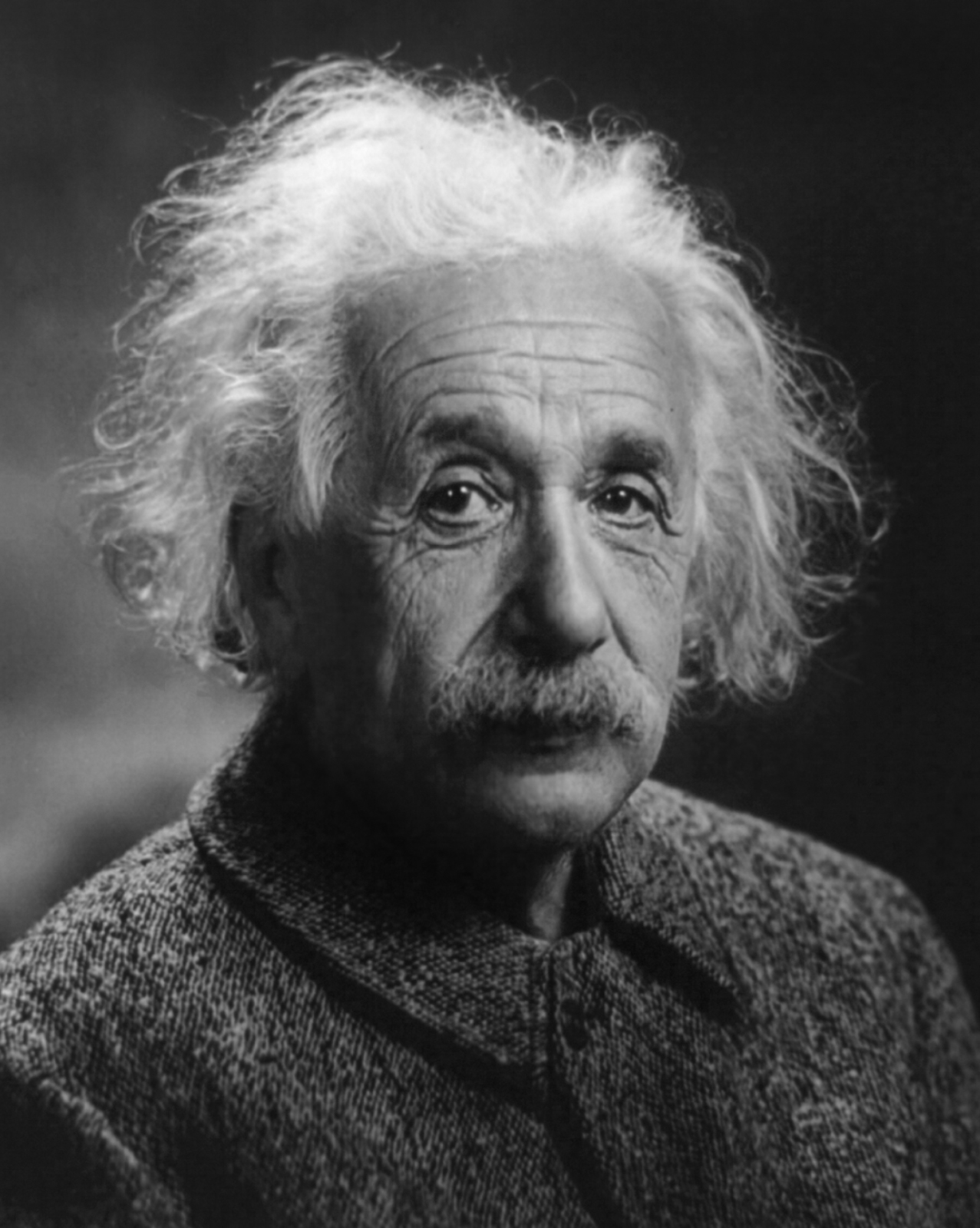
The European intellectual migration of the 1930s and 1940s was unprecedented and historic, because the upheaval in Europe was unprecedented. But America has been harboring refugees since before it was the United States of America, and those refugees have made enormous contributions to our society and particularly to our economy. All those people who didn't want to accept European refugees in 1938, those people who looked at all those Jewish doctors, scientists, filmmakers, and engineers and just saw some stereotypical rabble of ghetto urchins without shoes, were not just being un-American bigots, which they were, but also (like most bigots) they were being suckers. They were being given an enormous gift, a migrating flock of golden geese, and they could only see their own racist fantasies.
Refugee populations, now as then, include large numbers of people whom you could ordinarily never induce to leave their own countries for yours, including people who under ordinary circumstances would stay put because they were so successful in the old country. People with high degrees of skill and education, whom you could never manage to recruit otherwise, are forced to start over. Immigrants are a huge boost to the economy, period, but refugee groups include a heavy share of super-immigrants whom you're only getting because of historical disruptions. Their hard luck becomes our good luck. We should grab as many of those people as we can.
The Syrian refugees are also people who would not be going anywhere in the normal course of things. They are disproportionately educated, middle-class types who were comfortable and successful before the civil war tore their country apart. (And they are also typically more secular or cosmopolitan; these are the people "ISIS"/Daesh hates.) They are, in short, super-immigrants, with a much higher percentage of doctors, scientists and engineers than you see in standard immigrant populations. We should grab them. We should grab them now. These are people who could make our country grow. We would be stupid not to grab this chance when we can. And I never want to hear Americans kvetching about a shortage of math teachers again, ever.
I can accept that many of our politicians and our talking heads don't want to do the right thing. I've gotten used to that. I also accept, with my routine disappointment, that those people don't want to do the American thing. (But I will note how many Bible-thumping politicians are hellbent against doing the Christian thing.) But could we at least not do the stupid thing? Could we not be enormous suckers? Only a sucker would let a chance like this through our fingers. We have made it more than obvious over the past few days that we don't deserve good luck like this, but we should at least have the good sense to take it.
Is there a short-term cost to taking in refugees who need to start over? Sure. But that short-term cost has enormous long-term benefits, and will reach the break-even point pretty soon. Taking on short-term costs for long-term gain, or what people call "investing," is what capitalism is. And the United States is uniquely situated to make that small investment. Last time I checked, the US had the largest economy in the world, and next time I check that will still be true. Do you know how we got to have the largest economy in the world? Taking in refugees. It is our national business. It is our edge. It is what got us where we are, and we should stick to it. We would be idiots not to.
We have been building our country on refugees' industry, ingenuity, and prior education since before we called ourselves a country. I have particularly warm feelings for one group of refugees, fleeing religious persecution and political turmoil, who settled in my own native Massachusetts. Perhaps you might have heard of them yourself:

And with that, let me be the first to wish you a Happy Thanksgiving.
cross-posted from, and all comments welcome at, Dagblog
More than two-thirds of Americans were opposed to allowing refugees fleeing Hitler into the United States. But we eventually, grudgingly, mostly, did the right thing, and the influx of refugees into our country was wonderful for us. The United States got a huge infusion of European scientists, artists, and intellectuals, and an even larger group of bright, skilled professionals, tradesmen, business people, students, and workers. Those refugees helped us win the war, and they helped build America's postwar boom. They enriched America culturally and intellectually. They enriched America scientifically, in our universities and labs. And they straight-up enriched America, beginning new businesses and starting new careers.
Our gigantic economic expansion after World War Two also benefited from a big, free bonus helping of educated workers, educated on other countries' dimes. Our classic Hollywood movies are filled with refugee actors, written by refugee screenwriters, and directed by refugee directors. And refugee scientists helped win America win the war, not least the race for the atomic bomb, because we could count on Hitler and Mussolini for regular shipments of world-class physicists. Does the name "Fermi" ring a bell? Or perhaps some of you might remember this fellow:
The European intellectual migration of the 1930s and 1940s was unprecedented and historic, because the upheaval in Europe was unprecedented. But America has been harboring refugees since before it was the United States of America, and those refugees have made enormous contributions to our society and particularly to our economy. All those people who didn't want to accept European refugees in 1938, those people who looked at all those Jewish doctors, scientists, filmmakers, and engineers and just saw some stereotypical rabble of ghetto urchins without shoes, were not just being un-American bigots, which they were, but also (like most bigots) they were being suckers. They were being given an enormous gift, a migrating flock of golden geese, and they could only see their own racist fantasies.
Refugee populations, now as then, include large numbers of people whom you could ordinarily never induce to leave their own countries for yours, including people who under ordinary circumstances would stay put because they were so successful in the old country. People with high degrees of skill and education, whom you could never manage to recruit otherwise, are forced to start over. Immigrants are a huge boost to the economy, period, but refugee groups include a heavy share of super-immigrants whom you're only getting because of historical disruptions. Their hard luck becomes our good luck. We should grab as many of those people as we can.
The Syrian refugees are also people who would not be going anywhere in the normal course of things. They are disproportionately educated, middle-class types who were comfortable and successful before the civil war tore their country apart. (And they are also typically more secular or cosmopolitan; these are the people "ISIS"/Daesh hates.) They are, in short, super-immigrants, with a much higher percentage of doctors, scientists and engineers than you see in standard immigrant populations. We should grab them. We should grab them now. These are people who could make our country grow. We would be stupid not to grab this chance when we can. And I never want to hear Americans kvetching about a shortage of math teachers again, ever.
I can accept that many of our politicians and our talking heads don't want to do the right thing. I've gotten used to that. I also accept, with my routine disappointment, that those people don't want to do the American thing. (But I will note how many Bible-thumping politicians are hellbent against doing the Christian thing.) But could we at least not do the stupid thing? Could we not be enormous suckers? Only a sucker would let a chance like this through our fingers. We have made it more than obvious over the past few days that we don't deserve good luck like this, but we should at least have the good sense to take it.
Is there a short-term cost to taking in refugees who need to start over? Sure. But that short-term cost has enormous long-term benefits, and will reach the break-even point pretty soon. Taking on short-term costs for long-term gain, or what people call "investing," is what capitalism is. And the United States is uniquely situated to make that small investment. Last time I checked, the US had the largest economy in the world, and next time I check that will still be true. Do you know how we got to have the largest economy in the world? Taking in refugees. It is our national business. It is our edge. It is what got us where we are, and we should stick to it. We would be idiots not to.
We have been building our country on refugees' industry, ingenuity, and prior education since before we called ourselves a country. I have particularly warm feelings for one group of refugees, fleeing religious persecution and political turmoil, who settled in my own native Massachusetts. Perhaps you might have heard of them yourself:
And with that, let me be the first to wish you a Happy Thanksgiving.
cross-posted from, and all comments welcome at, Dagblog
Subscribe to:
Posts (Atom)


